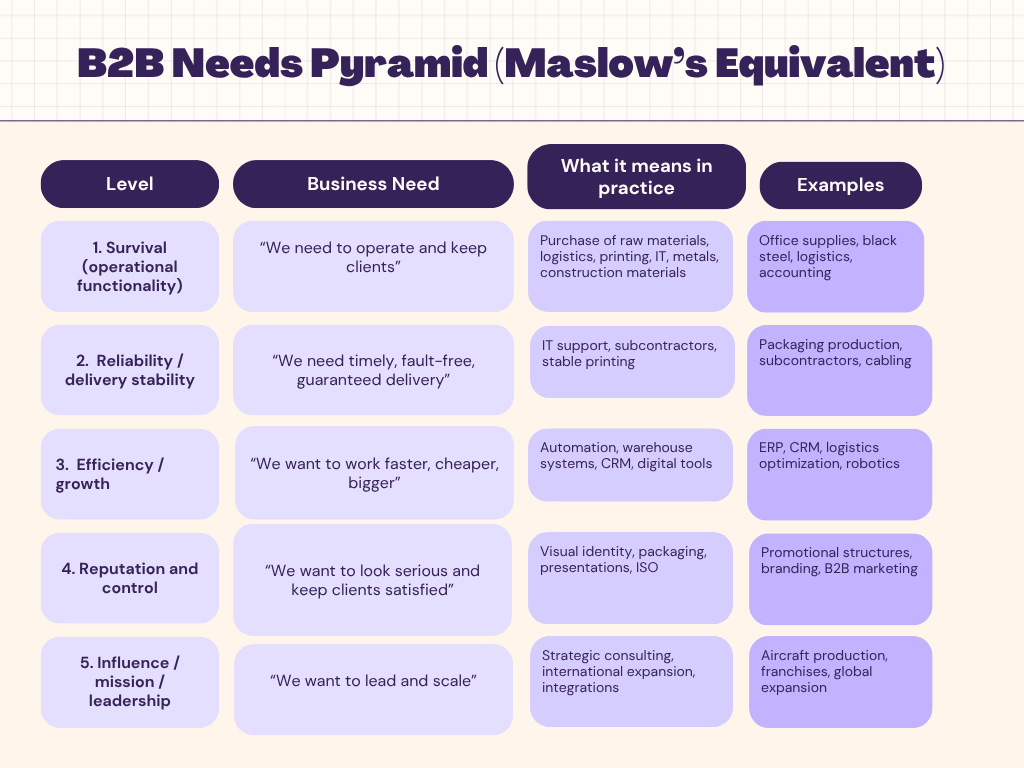
In marketing, Maslow’s pyramid has long been a steady concept — a model explaining what needs drive a person: from the desire to survive to the desire for self-realization. It is popular in B2C: when we talk about products for the end consumer, it helps build the right communication — from bread and salt to yoga and coaching. But when it comes to B2B, business-to-business, it seems like everything changes. As if there are no emotions, no needs, no evolution. Only deals, numbers, and logistics.
And this is a mistake. Because business is also a living organism. It also lives, fears, develops, wants recognition, and wants to stay in the system. It also has its own pyramid of needs. Only instead of sleep and food — it wants stable supply and automation. Instead of love and recognition — reputation, reliability, and market influence.
Every entrepreneur, every company is looking for something. Someone buys materials so their workshop does not stop. Someone implements a CRM so they do not lose clients. Someone hires a marketer so the brand is taken seriously. And someone is already thinking how to enter a new market, become a franchise, or set a standard for the whole industry. And each of these steps is not just an action, it is a need, and it sits on its own level in the hierarchy.
If a person is looking for a stationery supplier, they do not think about brand. They want it fast, cheap, and today. If a company is implementing an ERP system — they care about scale, accuracy, and control. And if they are going international — mission, influence, and leadership come first. Depending on what level the business is at right now, you need to choose the language, the tools, and the communication channel.
But in B2B marketing, this is often missing. We try to speak the same way with everyone: with those who are trying to save their business, and with those who are scaling it. And we miss the target. Because selling a strategy to someone who needs metal “for yesterday” is like offering a yacht to someone who is looking for bread.
Today, B2B is no longer hidden and “by connections.” Business comes to LinkedIn, makes landing pages, runs ads. Competition begins not only in products, but in trust, expertise, and the way you present yourself. And in this game, those who understand that the client also has pain, a level, and a path — they win. If you know how to see it — you are ahead.
So maybe it’s time to admit: B2B also has its own Maslow. Only on top of it there is not self-realization, but influence. Not happiness, but system. Not “I want”, but “I must, and I can do better.”
Look at the table — and define where you are:
The clearer you understand the level of needs you respond to, the easier it is to build a strategy: how to position yourself, what to talk about, to whom, and why.
In the next article, I will tell you how to build communication with a business client: which channels work at each level of need, what the message should be, and what to do to be heard and chosen.
And this is a mistake. Because business is also a living organism. It also lives, fears, develops, wants recognition, and wants to stay in the system. It also has its own pyramid of needs. Only instead of sleep and food — it wants stable supply and automation. Instead of love and recognition — reputation, reliability, and market influence.
Every entrepreneur, every company is looking for something. Someone buys materials so their workshop does not stop. Someone implements a CRM so they do not lose clients. Someone hires a marketer so the brand is taken seriously. And someone is already thinking how to enter a new market, become a franchise, or set a standard for the whole industry. And each of these steps is not just an action, it is a need, and it sits on its own level in the hierarchy.
If a person is looking for a stationery supplier, they do not think about brand. They want it fast, cheap, and today. If a company is implementing an ERP system — they care about scale, accuracy, and control. And if they are going international — mission, influence, and leadership come first. Depending on what level the business is at right now, you need to choose the language, the tools, and the communication channel.
But in B2B marketing, this is often missing. We try to speak the same way with everyone: with those who are trying to save their business, and with those who are scaling it. And we miss the target. Because selling a strategy to someone who needs metal “for yesterday” is like offering a yacht to someone who is looking for bread.
Today, B2B is no longer hidden and “by connections.” Business comes to LinkedIn, makes landing pages, runs ads. Competition begins not only in products, but in trust, expertise, and the way you present yourself. And in this game, those who understand that the client also has pain, a level, and a path — they win. If you know how to see it — you are ahead.
So maybe it’s time to admit: B2B also has its own Maslow. Only on top of it there is not self-realization, but influence. Not happiness, but system. Not “I want”, but “I must, and I can do better.”
Look at the table — and define where you are:
- What business need does your product or service meet?
- At what level does your company work in the B2B needs chain?
- What exactly do you offer: basic operational support, stability, growth, image — or strategic strengthening?
The clearer you understand the level of needs you respond to, the easier it is to build a strategy: how to position yourself, what to talk about, to whom, and why.
In the next article, I will tell you how to build communication with a business client: which channels work at each level of need, what the message should be, and what to do to be heard and chosen.